Loading...
Loading...
Bar-Ilan University Faculty of Law
Yuval Feldman is the Mori Lazarof Professor of Legal Research at Bar-Ilan University Faculty of Law, where he is the head of the ERC-funded Voluntary Compliance Lab and the Associate Dean for Research. He is also a professor of Psychology (by courtesy) in Bar-Ilan. He obtained his Ph.D. (Jurisprudence and Social Policy) from UC Berkeley in 2004 after receiving his LL.B. and B.A. (Psychology) from Bar-Ilan University (1998) and clerking for Supreme Court Justice Tova Stresberg-Cohen.
His areas of research include Behavioral Analysis of Law, Experimental Law and Economics, Behavioral Ethics, Computational Law, Regulation, Enforcement, and Compliance. From 2011 to 2013, he was a fellow in the Edmond J. Safra Institutional Corruption Lab at Harvard Law School and the Implicit Social Cognition Lab in Harvard Psychology. Between 2014-2023, he has been a Senior Fellow at the Israel Democracy Institute, where he published a series of white papers on behavioral aspects of discrimination, national laws, environment, corruption, regulation, solidarity, and trust.
Feldman has received numerous national fellowships, including Rothschild, Fulbright, Alon, and awards such as Zeltner (2008, Young), Chesin (2019, Senior Researcher), Bruno Award (2020), Fatal Award (2021), and Provost's Innovative Researcher (2023), as well as more than 25 competitive research grants. During the years 2022-2027, he holds the ERC Advanced Grant for his research on Generating Voluntary Compliance Across Doctrines and Nations.
He has co-authored close to 80 papers, many published in leading journals in law, public policy, management, and psychology. His first book, "The Law of Good People," was published by Cambridge University Press in June 2018. His second book, "Can the Public be Trusted," was published in 2025, also from Cambridge University Press.
Generating Voluntary Compliance: Integrating Behavioral and Regulatory Aspects of Governments' Ability to Trust Their Public's Cooperation, Ethicality, and Compliance
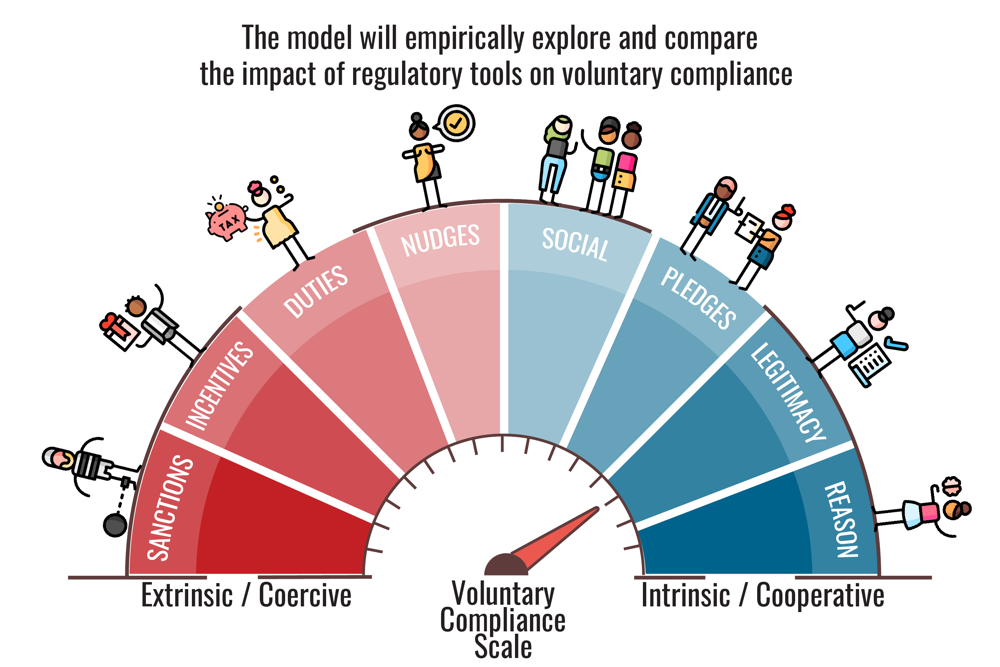
The VComp project investigates one of the most fundamental questions facing modern governance: how can governments generate voluntary compliance without relying solely on enforcement and coercion? Through an ERC Advanced Grant, our lab examines the full spectrum of regulatory tools available to governments, from the most coercive measures like sanctions and incentives to the most cooperative approaches like legitimacy appeals and moral reasoning.
A central feature of this research program is its cross-national comparative perspective. By studying compliance behavior across different legal systems, cultures, and regulatory traditions, we aim to understand which tools work best in which contexts, and why certain populations respond more favorably to cooperative governance strategies while others require stronger regulatory signals.
Our multidisciplinary approach draws on insights from behavioral science, law, psychology, and public policy to develop a new theoretical and empirical framework for understanding the conditions under which voluntary compliance thrives.

Behavioral Regulation
17 projects

Compliance & Enforcement
4 projects

Ethics & Internalization
4 projects

Trust & Cooperation
1 projects
Our model empirically explores and compares the impact of regulatory tools on voluntary compliance — from extrinsic, coercive measures like sanctions and incentives to intrinsic, cooperative approaches like legitimacy and moral reasoning.
The scale spans from Sanctions and Incentives through Nudges and Social Norms to Pledges, Legitimacy, and Reason — mapping the full spectrum of government-citizen trust.
The VComp project is funded by an ERC Advanced Grant (No. 101054656) under the European Union's Horizon Europe research and innovation programme. The ERC is the premier European funding organisation for frontier research.

The VComp Lab is based at the Faculty of Law at Bar-Ilan University in Israel. Bar-Ilan is one of the country's leading research universities, providing an interdisciplinary environment for the study of law, behavioral science, and regulation.